Start with the finished film.
One photographer. Four ages. A camera that keeps moving while the people and places around him change.
This guide is the complete process behind my aging reel: developing a personal idea with ChatGPT / Astra, blocking the movement in 3D Jutsu, preparing characters and locations, generating in Higgsfield Cinema Studio, then assembling the strongest moments from roughly four generated videos in DaVinci Resolve.
Assembled from roughly four generations using the same or slightly revised prompt, with cuts hidden behind foreground objects. The 28-second brief becomes a shorter final film.
Realistic film above, 3D blocking below, with the hook and a four-second end card.
Creative conversation, scene structure, prompt writing and revisions. Use Astra where it is available in your model selector.
Simple staging, a real camera path and a timing reference for the whole film.
Character and visual development. Reference edits and age corrections can use other image models inside Higgsfield.
Environment stills, reference assembly and cinematic source videos for the edit.
Final assembly, hidden cuts, sound, a subtle color grade and Film Look Creator.
Background music and whip sound effects added during the final edit.
Make the idea personal.
I already knew the camera move I wanted. The story came from asking what should stay with me while everything else changes.
For this film, photography is the thread. The same camera starts as a working tool, becomes something to share with my grandson, rests on my lap, and remains after I leave. The orbit gives the film its structure; the object gives it meaning.
Start your own conversation here
Give the assistant real details to work with. A worn guitar, a sketchbook, a kitchen, a dog or a familiar window may carry more meaning than an elaborate future city.
Find your own conceptReconstructed working prompt · English · click to expand
Act as my creative director. Help me design a short cinematic film about my future self. Start by asking me five specific questions: what defines me, which people matter to me, which object could represent my life, which everyday places feel personal, and what emotion the ending should leave behind. Do not invent personal facts about me.

I want the camera to orbit horizontally in one consistent direction. Every time it disappears behind a real foreground object, we enter another stage of my life. The camera moves faster through the occlusion, slows as the next moment is revealed, is slowest at the emotional centre, then accelerates toward the next occlusion. People continue moving at natural speed.

After I answer, propose a 28-second story with seven timed beats. Give each beat one readable human action, a location, an age, a recurring object and a motivated foreground occluder. Keep the same person's identity across ages. Build the meaning from my answers rather than copying somebody else's family or career. Explain how the last two beats could be alternate passes for the edit. First agree the written concept with me; then develop the blocking and reference prompts.
Six moments. One visual rule.
The finished story has six moments, ending on one heavily overgrown memorial. The time labels below refer to the original 28-second generation brief, which requested two passes of that same old stone. I removed one of those loops in the edit.
The work
I raise my camera in the studio and take one photograph. The object and the person are introduced together.
The person beside you
A quiet dinner with my wife. A closer two-shot, a look and a small smile. The camera has its own place on the table.
The next generation
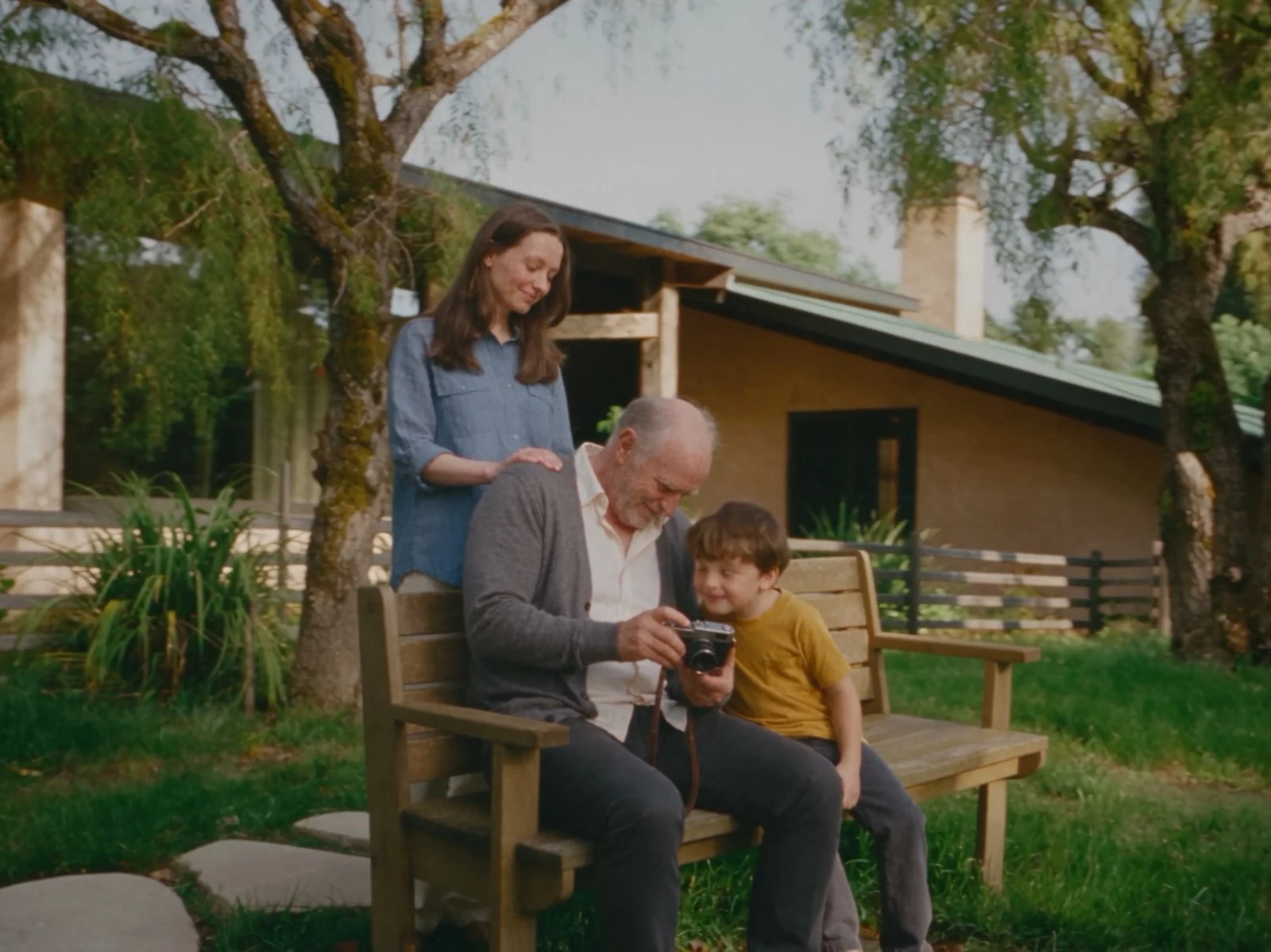
My grandson sits beside me on a bench. My daughter stands behind us. A shutter click becomes a small shared moment.
A little more stillness
A chair by the sea. The camera rests on my lap. A very distant future aircraft quietly places this moment later in time.
The absence
The same chair, same place, same camera. The person is gone. Keeping the setting familiar makes the change readable.
What remains
One final passage across a heavily overgrown memorial. The generation provided two loops of this same old stone; I kept only one in the finished film.
Five unique locations, not seven. Reuse the terrace for the occupied and empty chair. Reuse the memorial garden for both final passes. Continuity is easier when you stop generating a new place for every beat.
Give the model a camera to follow.
The blocking tells the model where to look, how fast to travel, and when the next part of the story begins.
In 3D Jutsu, begin with simple figures, readable furniture and a camera. The goal is an editable spatial rehearsal. Every scene needs a clear subject, a small action and an object that can fully hide the frame during a transition.
Move behind a wall edge, rooted tree or structural support.
The camera is slowest when the main action is near the centre.
Finish the human reaction before entering the next wipe.
A horizontal orbit is a spatial move
The viewpoint travels around the subject with parallax. The world should not rotate around a stationary camera. Keep a level horizon and one travel direction. The actors keep their natural speed even while the camera speeds up.
Use an architectural edge indoors and a tree outdoors. A random column can hide the cut, but a believable object makes the transition feel part of the place. During the central beat it must move clear of faces and hands.
| Full-cover moment | Reveal next | What the wipe hides |
|---|---|---|
| 4.0 s | Dinner | Age, setting and the closer two-shot |
| 7.4 s | Garden | Age and a new three-person arrangement |
| 12.4 s | Terrace | Age and location |
| 16.4 s | Empty chair | The person disappearing; furniture stays fixed |
| 20.4 s | Memorial | The final location change |
| 25.0 s | Memorial, second pass | An alternate pass; no change of age or condition |
Brief 3D Jutsu with the whole storyReconstructed working prompt · English · click to expand
Build a simple editable 3D blocking scene for a 28-second film in 4:3. It tells the life of one photographer through the same horizontal orbital camera movement. This is a camera-and-staging reference, not the final visual render. Use simple human figures, clear furniture, believable proportions and stable geometry.

TIMELINE
0.0–4.0: age 36, standing in a photography studio. He holds one small camera below his face, raises it and takes one picture around 2s. Softbox on the left; backdrop behind him on the right.
4.0–7.4: age 50, an intimate dinner with his wife at a dark rectangular table. Two chairs. Both faces readable in a closer waist-up two-shot. Each person's hands remain separately on their own side of the table. Camera prop rests in its own clear area.
7.4–12.4: age 70, sitting with his seven-year-old grandson on a wooden garden bench. His forty-year-old daughter stands slightly behind and screen-left. Exactly three people. No table. Grandfather tips the camera toward the boy, presses the shutter once, the boy looks up and smiles, grandfather and daughter react in sequence. He keeps the camera; the boy's hands stay on his own knees.
12.4–16.4: age 90, seated in a green armchair on a seaside terrace, camera on his lap. One small side table remains beside the same armrest. Complete chair and feet visible.
16.4–20.4: identical terrace and framing, but the chair is now empty. The camera remains on its cushion. Keep furniture placement, chair scale and horizon consistent.
20.4–25.0: first close pass of an old upright memorial stone in an overgrown garden. Reserve its shape; text and final vegetation detail will come from image references and generation.
25.0–28.0: second close pass of that SAME memorial at the SAME time, in the SAME condition. It is an alternative ending for editing, not an additional age jump.

CAMERA
Orbit horizontally in one consistent direction with a level horizon. Move through space with real parallax; do not rotate the world around a static camera. Use a natural perspective around 35mm as a starting point and adjust distance to read each action. Speed up toward and through the foreground wipe; slow down on reveal; move slowest across the central emotional action. Actor motion remains at normal speed.
At 4.0,7.4,12.4,16.4,20.4 and25.0 seconds fully hide the image behind a real foreground object. Hide any scene swap while the frame is completely covered. Indoors use doorway or wall edges, in the garden use a rooted tree trunk, on the terrace use a structural support. These belong to the scene; no random floating columns. They must clear faces during the main moment.
Establish the closer dinner framing during the covered transition. Keep terrace framing consistent when the man disappears. No added revolutions, camera flips, visible morphing or dissolves.

Keep one clean camera output, sensible scene names and timing markers. Add only the gestures needed to communicate the actions; avoid overlapping hands or limbs. Render a preview and check every reveal before adding visual detail. Return the complete 28-second playblast, without interface overlays.
Approve the rough version first
Check camera height, framing, occluders and timing before polishing geometry. At dinner, keep the hands separated even in the blocking. Do not assume a sentence about “natural physics” will erase every intersection the video reference shows.
The supplied blocking file is 30 fps; the selected AI film is 24 fps. This guide uses seconds for timing. In the edit, match the events and wipes rather than equating frame numbers across the two files.
Build a cast before a scene.
One clear portrait. One complete front view. One complete back view. The same person in all three.
Our early sheets drifted: the older versions looked too young, skin became plastic, and one daughter sheet returned only face close-ups. The reliable layout is explicit about what each panel shows — including the floor below both shoes.
Use a neutral grey background and broad natural-looking light. Save dramatic colour and hard shadows for the locations. Keep identity, hairstyle and clothing consistent across the three views. Unlike the earlier horse guide, this project uses full figures with their heads attached.
Dodas · 36
The current identity. The source file is named 30.png, but the intended age is 36.
Dodas · 50
Salt-and-pepper hair, visible middle age, the tan polo.
Dodas · 70
Thinner silver hair, aged face and hands, grey cardigan.
Dodas · 90
Sparse white hair, advanced aging and delicate skin texture.
Wife · 50
Dinner only. Olive-grey dress, distinct identity and natural middle age.
Daughter · about 40
Garden only. Long brown hair, blue shirt, cream trousers.
Grandson · about 7
A newly created fictional character, in mustard yellow and navy.
Which image tool did what?
Soul Cinema is useful for cinematic image development. We also used Soul 2.0 text-only generation for the daughter and grandson. Aging corrections were separate reference-editing passes in Higgsfield; the archived prompts include Nano Banana and GPT Image 2.5 work. The ninety-year-old sheet and the wife needed explicit realism corrections.
Current-age identity sheet · 36Reconstructed working prompt · English · click to expand
Create a wide horizontal photographic character reference sheet of the SAME 36-year-old man. Use the supplied identity reference in an image-editing model that accepts both the reference and written instructions. Preserve his recognizable facial proportions, hairline, eyes, nose, mouth and natural asymmetry.

Exactly three views on one neutral medium-grey studio backdrop:
LEFT: a large straight-on head-and-shoulders portrait, entire head visible, looking calmly toward the camera.
CENTRE: complete full body from the top of the head to the soles, directly from the front, arms relaxed at his sides and hands empty. Include floor below both shoes.
RIGHT: complete full body directly from the back, entire head and both shoes visible. The face is not visible. Both full-body figures have matching scale and floor level.

A natural healthy adult of 36, short brown hair with his existing hairline, short beard, realistic skin and ordinary small imperfections. Ivory linen button-up shirt with the sleeves rolled to the forearms, charcoal straight trousers and brown low leather shoes, consistent in every panel. No props.
Broad soft window daylight with gentle ambient fill, neutral exposure and restrained contrast. Natural pores, soft individual hairs and real fabric folds. Unretouched casting photography. No beauty filter, waxy skin, CGI, artificial wrinkle pattern, extra views, labels or borders. Exactly ONE close-up and TWO complete standing bodies, with their heads attached.
Age correction · 50Archived project prompt · English · click to expand
Edit the supplied three-view character sheet in place. Preserve the exact same man and his distinctive facial identity: eye spacing, brown eyes, nose structure, mouth and ears. Change his biological age consistently in ALL THREE views: large portrait at left, full-length front center, full-length back right. Preserve panel widths, framing, gray studio backdrop, soft neutral lighting, outfit design/colors, shoes, and neutral expression. This is age progression for a film, not a new actor or a cosmetic gray-hair filter. No labels, props, extra panels or added people. Make him convincingly 50 years old, visibly twenty years older than the young-looking input. Moderate horizontal forehead creases, crow's feet visible at rest, mild lower-eyelid bags, nasolabial folds, slight jawline softening and early neck creases. Hair still partly brown but distinctly salt-and-pepper with gray temples, moderately receding hairline, short beard about half gray. Mature hand texture. Keep a healthy middle-aged build and upright stance. Hair color and recession must match in the portrait, small frontal head and back of head. Keep all tan polo details unchanged. Do not merely reproduce the youthful face of the input; noticeably age facial tissues while retaining likeness. Real photographic skin detail, not overlaid wrinkle scratches.
Age correction · 70Archived project prompt · English · click to expand
Edit the supplied three-view character sheet in place. Preserve the exact same man and his distinctive facial identity: eye spacing, brown eyes, nose structure, mouth and ears. Change his biological age consistently in ALL THREE views: large portrait at left, full-length front center, full-length back right. Preserve panel widths, framing, gray studio backdrop, soft neutral lighting, outfit design/colors, shoes, and neutral expression. This is age progression for a film, not a new actor or a cosmetic gray-hair filter. No labels, props, extra panels or added people. Make this man unmistakably 70 years old, rather than the 40-year-old appearance of the input. Substantially aged facial tissues: deeper forehead lines and crow's feet, hooded upper lids, visible under-eye bags, pronounced nasolabial folds, modest cheek volume loss and jowls, loose creased neck skin. Hair predominantly silver-white (85 percent gray), noticeably thinner and receded at temples and crown; short silver-gray beard. Age spots and fine wrinkles on face and hands, visible tendons on hands. Slight muscle loss and modest relaxed upper-back posture, still independently standing. Match aged head, gray hair and neck in ALL THREE panels including small full-body face and back of head. Preserve gray cardigan, white shirt, dark trousers and shoes as supplied. Natural photographic aging, neither a youthful man with dyed hair nor a generic unrelated elderly face.
Age correction · 90Archived project prompt · English · click to expand
Edit the supplied three-view character sheet in place. Preserve the exact same man and his distinctive facial identity: eye spacing, brown eyes, nose structure, mouth and ears. Change his biological age consistently in ALL THREE views: large portrait at left, full-length front center, full-length back right. Preserve panel widths, framing, gray studio backdrop, soft neutral lighting, outfit design/colors, shoes, and neutral expression. This is age progression for a film, not a new actor or a cosmetic gray-hair filter. No labels, props, extra panels or added people. Make this man unequivocally 90 years old: a very elderly nonagenarian, substantially older than 70. The input looks much too young. Transform facial tissue with significant cheek and temple volume loss, deep organic forehead and eye wrinkles, hooded lids and bags below the eyes, pronounced folds beside nose and mouth, thin lips, loose jowls and clearly hanging finely wrinkled neck skin. Sparse wispy entirely white hair, markedly receded hairline and broad thinning crown with visible scalp; thin short white beard, graying eyebrows. Age spots and fine crepey skin, bony veined elderly hands. Leaner limbs and torso, gently rounded upper back and forward neck with a dignified comfortable standing stance. Maintain his distinctive recognizable face underneath natural aging; not skeletal, grotesque or diseased. Apply the SAME advanced age to large portrait, small frontal face, hands and full back view including scalp. Preserve his light-taupe cardigan, ivory shirt, gray trousers, shoes and exact three-panel composition. Face must read immediately as ninety, not fifty with gray hair.
Remove the plastic look · 90Archived project prompt · GPT Image 2.5 · English · click to expand
Edit the attached three-view character reference sheet to look like actual unretouched photographs of this same ninety-year-old man. Preserve his exact recognizable face, advanced age, sparse white hair, short white beard, physique, taupe cardigan, ivory shirt, gray trousers, brown shoes, gray backdrop, panel layout and all three viewpoints. Left is large front portrait; middle full body front; right full body back. Do not change the person or make him younger.
The problem to fix is waxy synthetic skin and artificially carved repetitive wrinkle lines. Reinterpret the skin as real, delicate elderly human tissue photographed in a casting studio: irregular fine creases of varying depth and length, softened crease edges, subtle broken capillaries beside the nose, restrained uneven pigmentation, natural translucent thin skin, tiny pores visible only where appropriate, sparse individual vellus hairs, realistic eyelid margins and moist eyes with modest catchlights. Keep the deep age-related folds but remove the etched uniform grooves, excessive sharpening and smooth plastic surfaces between them. Age spots should have diffuse irregular edges and subtle tone variation. Lips have natural fine texture, beard consists of irregular soft individual hairs rather than a white painted edge. Match skin response in face, neck and hands across views.
Lighting: broad diffused window light from camera left with gentle ambient fill, neutral color, modest contrast and natural highlight falloff. Avoid beauty glow or overly uniform studio illumination. Photographic optical softness at fine-detail scale without blurring the image; restrained sensor texture, no fake heavy film-grain overlay. Knit and cotton retain authentic fine irregular fibers and relaxed folds. Documentary portrait / real casting photographs, grounded and understated. No CGI, wax sculpture, silicone aging prosthetics, airbrushing, HDR, clarity halos, hyperdetail or stylized dramatic grading. Return the complete original triptych, no text or new objects.
Wife · believable age 50Archived project prompt · reference edit · English · click to expand
Edit this exact reference character sheet. Age the SAME woman to a believable 50 years old. Preserve her recognisable identity: facial bone structure, green-hazel eye colour, nose, mouth, face shape and natural asymmetry. Preserve the exact three-panel composition: left large straight-on head-and-upper-chest portrait with eyes open, middle complete head-to-toe frontal body, right complete head-to-toe rear body. All three views show the same 50-year-old woman at the same session. Keep her height, build, neutral expression, poses, shoulder-length brown hairstyle, exact olive-grey short-sleeved scoop-neck midi dress, brown sandals, framing and neutral grey studio backdrop.
Make the age visibly read as fifty in an authentic unretouched casting photograph: subtly reduced cheek fullness, gently softer jawline, modest natural upper-eyelid hooding, fine irregular crow's feet at rest, a few shallow forehead lines, realistic under-eye creases and mild hollows, slightly deeper nasolabial folds, delicate neck creases and age-appropriate skin on hands and forearms. Natural healthy middle age, not frail or elderly. Keep predominantly brown hair with only a few subtle grey strands near temples. Do not change her ethnicity or create a different woman.
The foremost priority is photographic realism. Soft broad daylight from one side and gentle ambient fill, natural exposure, ordinary restrained colour. Skin must look living and supple with nonuniform fine pores, subtle freckles and small pigmentation variations, tiny vellus hairs, soft subsurface colour and different texture across cheeks, eyelids and neck. Allow natural imperfections and mildly uneven skin tone. Wrinkles must follow underlying anatomy and vary in depth, spacing and visibility. Avoid waxy smooth skin, plastic shine, beauty retouching, glamour makeup, airbrushing, CG rendering, oversharpened gritty pores, uniform engraved wrinkle patterns, exaggerated aging makeup, excessive skin sagging or fully grey hair. Retain realistic fabric weave and individual hair strands. Output a high-resolution natural photographic character reference sheet, without text, labels, borders, props or additional views.
Daughter · layout-first sheetArchived project prompt · Soul 2.0, text only · English · click to expand
A WIDE HORIZONTAL CHARACTER SHEET with ONE HEADSHOT and TWO FULL-LENGTH STANDING FIGURES against a plain medium-grey studio cloth backdrop. Three distinct side-by-side camera framings:
LEFT PANEL: frontal head-and-shoulders photograph, entire head visible.
MIDDLE PANEL: FULL BODY FRONT VIEW photographed from several metres away. Show the whole standing woman, including her head, shoulders, chest, waist, hips, arms, hands, entire legs and both shoes, with visible grey floor below her shoes. Her head is small within this full-length panel, approximately one seventh of the figure's height. Camera level, straight-on, no overhead angle.
RIGHT PANEL: FULL BODY BACK VIEW photographed from several metres away. Show the whole same woman from the BACK, including the back of her head, shirt, arms, hands, trousers, entire legs and both shoes, with grey floor below her shoes. Her face is not visible. Camera level, straight-on.
The two full-length figures have identical scale and floor level. Exactly ONE close-up, on the left only. The middle and right panels must show two complete bodies, not faces or cropped portraits.

SUBJECT: the same adult woman aged forty in all three panels. A softly oval face, relatively broad forehead, gentle cheeks tapering to a small rounded chin. Narrow, horizontally almond-shaped brown-grey eyes with relaxed upper lids; fine light-brown mostly straight eyebrows; small straight nose with a softly rounded tip; modest mouth with a thin upper lip and slightly fuller lower lip. Calm neutral closed-mouth expression. Long chestnut-brown hair, side-parted, smooth near the scalp and loosely wavy through the lengths to mid-back. Natural adult anatomy, subtle fine eye and smile lines appropriate to forty, soft healthy cheeks.

WARDROBE: dusty-blue linen button-front shirt with sleeves rolled below elbows, cream straight-leg trousers and tan flat leather shoes. Same clothes in every panel. Relaxed upright stance, arms down, hands empty.

Soft broad window daylight from camera left with ambient fill, neutral colour, matte medium-grey backdrop and floor throughout. Unretouched realistic casting photography, natural skin and hair texture, restrained contrast. No text, labels, props or borders. No beauty retouching or CGI. Prioritise correct full-body framing in the middle and right panels.
Grandson · natural casting sheetArchived project prompt · Soul 2.0, text only · English · click to expand
A realistic photographic character reference sheet showing one fictional seven-year-old boy in three views. He is an ordinary child cast as a grandson in a grounded live-action family film. He has short, slightly messy medium brown hair with fine flyaway strands, hazel eyes of normal size, a softly rounded child face, a small nose, a few faint irregular freckles on his nose and cheeks, natural ears, and a relaxed closed mouth with a slight uneven half-smile. His expression is quiet and curious, like a child waiting for a photographer to take the picture. Natural seven-year-old body proportions, normal build and posture.
The same boy wears exactly the same clothes in all three views: a plain muted mustard-yellow cotton crew-neck short-sleeved T-shirt, relaxed dusty navy cotton trousers reaching the ankles, and slightly worn off-white canvas low-top sneakers with light grey soles. No logos or graphics. Hands empty. Real fabric folds, slightly wrinkled T-shirt, casually worn everyday clothing.
Create a horizontal 16:9 photographic triptych. LEFT THIRD: large straight-on head-and-upper-chest portrait, entire head and hair visible, eyes open looking into the camera. CENTER THIRD: full-length straight-on view, entire body from top of head to soles of both shoes with comfortable margin, arms relaxed down, fingers visible, feet comfortably apart. RIGHT THIRD: full-length direct rear view of the exact same child, head to soles with comfortable margin, same stance. Both full-length figures have matching height, scale and floor level. Exactly three views, consistent identity, haircut, proportions and clothing throughout.
Plain neutral medium-grey fabric backdrop and grey floor in a modest photography studio. Broad soft daylight from a window to camera left with gentle ambient fill; small soft natural eye reflections and subtle shadows. The visual quality of an unretouched documentary casting session, with natural exposure, quiet colours and slight optical softness. Living child skin is naturally smooth but has gentle irregular changes of colour, faint cheek redness, subtle peach fuzz and small everyday imperfections. Natural asymmetry of eyelids, eyebrows and mouth. Loose individual hair strands, normal natural lips. Everything looks physically photographed with an ordinary camera.
No idealised catalogue model, no doll face, no exaggerated large glassy eyes, no waxy skin, no beauty filter, no airbrushing, no makeup, no CGI or illustration, no HDR or crunchy oversharpening, no artificial uniform skin texture, no adult pores or wrinkles, no theatrical lighting. No extra people, extra limbs, props, text, labels, panel borders or watermark.
The daughter is an imagined adult character inspired by the supplied photograph and visual description, not a reliable forecast of her future face. For your own project, replace these identities and personal details with your own references.
Age the structure, not just the hair
Look at eyelids, cheek volume, jawline, neck, hair density, posture and hands. A youthful face with white hair still reads young. At the same time, uniform carved wrinkles and excessive sharpness can make a convincing age look like silicone. Match age across the large portrait and both smaller bodies before upscaling.
Design the places. Leave room for life.
The location still is an empty set. Characters and the recurring camera come later.
Generate these in Higgsfield’s Cinematic Locations workflow, also referred to here as Cinema Location. Use Soul Cinema when exploring a filmic visual direction. Keep the intended framing, light and material language aligned across the project.
A location image sets the appearance. The blocking supplies the moving perspective. They do not need to be identical screenshots, but their geometry must make sense together: the same bench orientation, enough space for people, and a plausible foreground edge for the wipe.
The studio
A clear standing area between the softbox and backdrop. We moved toward a cleaner interior so the photographer remains the main subject.
The studio · location promptReconstructed cleaner variant · English · click to expand
A single photorealistic cinematic location still, horizontal 4:3. An empty personal photography studio in the present day, intimate and genuinely used, with warm-grey plaster walls, a pale warm concrete floor and dark wooden skirting. An octagonal softbox on a slender black tripod stands on the left. A grey seamless photography backdrop hangs from a metal crossbar in the rear right, its paper sweeping naturally onto the floor. A single modest wooden shelf and a few carefully spaced framed photographs add personal character. Keep the room clean, ordered and uncluttered.

Leave a generous unobstructed standing area in the central midground, between the softbox and the backdrop. Keep all light stands and furniture outside this area. A real structural wall return is partially visible at the extreme foreground edge, establishing depth without obscuring the central space.

Eye-level camera approximately 1.5 metres high, natural 35mm lens perspective, medium-wide view into the room. Soft window daylight from camera left, gentle warm reflected light, restrained contrast, realistic slightly worn surfaces and subtle film grain. Quiet, personal live-action cinema rather than a pristine equipment showroom. One coherent physical room with believable depth. No people, mannequins, handheld cameras, text overlays, borders or collage. No illustration or CGI appearance.
The dining room
This is the replacement room used late in the process: dark table, high-backed chairs, warm wood and a broad dusk window. It replaces the earlier square-oak-table description.
The dining room · location promptReconstructed for the selected final room · English · click to expand
A single photorealistic cinematic location still, horizontal 4:3. An empty intimate dining room with warm natural wood wall panels, a broad window onto garden foliage at blue dusk, a dark rectangular table and exactly two high-back wooden dining chairs. Two understated ceramic place settings occupy separate areas; preserve a broad clear strip of tabletop between them and a small additional clear area for a camera prop to be placed later. The furniture must offer two seating positions with both faces readable from the future camera angle.
A real dark doorway edge appears only at the extreme foreground left. It provides depth without covering the two seating positions. Frame this as an intimate view across the table, rather than a distant wide shot of the entire room. Eye-level natural perspective, warm soft interior light against the cooler dusk outside, realistic wood grain and relaxed lived-in materials. Restrained cinematic colour and subtle grain.
One coherent empty room. No people, mannequins, hands, photographic cameras, text, collage or borders. Keep the furniture believable and reserve space for two complete upper bodies to be added later.
The family garden
The final garden reference I used: a wooden bench, stepping stones, a rustic fence and a low house beneath mature trees. Leave room behind the bench for the daughter, with a tree close to the camera for the transition. No table.
The family garden · location promptArchived project prompt · English · click to expand
A single photorealistic cinematic location still, horizontal 4:3. An empty, mature family garden around the year 2060, peaceful in late-afternoon light. A simple well-used wooden garden bench with a slatted back and a seat wide enough for two people stands in the central midground, facing the camera with a very slight three-quarter angle. Show the complete bench and leave clear standing space beside and immediately behind its left end. There is no table in front of or beside the bench.

A loose line of irregular flat stepping stones curves across the lower foreground through natural grass. A low rustic horizontal wooden fence runs behind the bench. Two mature deciduous trees frame the garden without overlapping the bench's central seating area. Behind the fence, slightly to the right, stands a modest modernised family house: warm mineral walls, broad glazing, a thin green roof and a lightweight canopy with slender adjustable slats. The architecture is quietly advanced and softened by established vegetation. A narrow slice of a nearer irregular tree trunk may enter the extreme foreground edge, with its base naturally rooted in the lawn.

Eye-level camera approximately 1.4 metres high, natural 35mm lens perspective, a medium-wide composition in which the bench is clearly readable rather than tiny in a huge lawn. Warm side light filtered through foliage, gentle ambient fill, soft leaf shadows, authentic weathered wood and restrained natural colours. A grounded live-action family film still. No people, mannequins, tables, photographic cameras, robots, holograms, text or collage.
The terrace
Use the same still for the ninety-year-old and the empty-chair scene. The furniture and horizon must survive the transition.
The terrace · location promptArchived project prompt · English · click to expand
A single photorealistic cinematic location still, horizontal 4:3. An empty private seaside terrace around the year 2080, quiet and contemplative. A comfortable dark muted-green armchair with a high rectangular back, broad armrests, pale natural seat cushion and short wooden legs stands slightly right of centre. Its seat faces almost toward the camera, angled gently toward the open sea on the right. A small round wooden side table stands immediately to the left of the armchair. Show the entire chair, its seat, all supporting legs and the complete side table, leaving space around them.

Warm pale limestone terrace flooring, an almost frameless transparent glass balustrade and an uninterrupted sea horizon in the distance. A thin softly curved canopy shelters the terrace and is visible along the upper edge. A warm mineral-plaster side wall at the far left and a slender integrated support near the far right belong to the same building and leave a broad open view of the sea. Very subtle recessed floor lighting and refined structural details suggest mature future architecture. Comfortable, human and believable.

Eye-level 35mm lens view, camera approximately 1.4 metres above the terrace floor. Soft late-afternoon coastal light from the left, pale blue sea, gentle warm highlights and quiet natural shadows. Restrained cinematic colour, realistic materials and subtle film grain. One continuous level horizon. No people, mannequins, photographic cameras, aircraft, flying vehicles, boats, floating structures, text or collage. The armchair seat remains empty and clearly visible.
The memorial garden
Our first still was too distant. Describe a close reserved site with foreground texture, then add the memorial as a separate prop during video generation.
The memorial garden · location promptReconstructed close-framing revision · English · click to expand
A single photorealistic cinematic location still, horizontal 4:3. A close, intimate view of an empty memorial site within an overgrown garden. The viewpoint is only a few metres from a small flat patch of earth in the central foreground, reserved for one upright stone and its low base to be added later. Frame for that future stone to occupy much of the central image, not as a tiny distant landmark. Ground texture is large and tangible in the lower foreground.
A rooted mature tree trunk enters the extreme left foreground as a natural camera wipe. Two slender cypresses stand several metres behind the reserved site, with a softly sloping landscape and more distant trees beyond. Irregular tall grass, ferns, moss and creeping plants gather around the patch and almost conceal an old path. Keep a central opening for the stone, not an empty large lawn. Near vegetation has readable texture; distant foliage is gently softened.
Camera about 1.2 metres high, natural 50mm-like perspective and restrained depth of field. Quiet soft side daylight, muted natural greens, delicate shadows and realistic optical texture. No people, gravestone, marker stake, inscriptions, flowers, candles, film border or montage. Do not pull back into a wide establishing shot.
Give the story one familiar object.
The silver-and-black film camera is the visual link between the ages. A dedicated props sheet tells the model that the camera in the studio, on the dinner table, with the grandson and on the empty chair is one object.
Recurring camera · props sheetReconstructed working prompt · English · click to expand
Create a photorealistic props reference sheet of ONE recurring vintage film camera, a compact silver-and-black metal camera with a black textured grip, one normal prime lens and a soft brown leather neck strap. Exactly the same object, lens, controls, dimensions and wear in every view.
One horizontal sheet with a clear front three-quarter view, a direct rear view and a smaller top view. Keep the whole camera visible in each view, including the strap arranged naturally beside it. The views must be distinct and easy to read, not a decorative collage. Restrained light wear, realistic brushed metal, textured leather and clean optical glass. No invented extra lenses or duplicate shutters.
Plain neutral grey seamless studio background and floor. Broad diffuse natural-looking light, modest contrast, soft contact shadows. High-resolution product reference photography. No hands, people, location, text labels, added logos, dramatic lighting or CGI gloss. This is an object identity sheet, not a scene.
Memorial stone · studio props sheetReconstructed working prompt · English · click to expand
Create a realistic studio props reference sheet of one upright memorial stone with a low rectangular base. Show the complete object from the front, a three-quarter angle and the back, consistent in shape, size and material across all views. Restrained warm-grey natural stone, simple rounded top, fine natural mineral texture.
Physically engrave a small photographic aperture symbol and the following four lines into the front face, preserving this exact spelling and line arrangement:
Dodas
Jagušák
f/9.0
The light remains.
The letters and aperture mark are cut into the stone itself: shallow recessed grooves with real inner shadow and bevels following the surface. No printed ink, painted letters, floating typography, metallic letters or text overlay. Keep the name readable.
Neutral grey studio backdrop, broad diffused daylight, natural surface detail and soft contact shadows. No cemetery, landscape, people, flowers, crosses or decorative collage. This clean props sheet defines geometry and engraving; the final video must replace its clean surface with heavy weathering, moss and overgrowth.
The clean sheet is not the final condition
The memorial reference defines geometry and engraving. The video prompt explicitly overrides its clean surface with irregular lichen, moss, weathering and tall vegetation. In both final passes it is already decades old.
“Physically engraved” matters: the letters should have depth within the stone, not sit on top like a graphic overlay. The intended engraved inscription is Dodas / Jagušák / f/9.0 / The light remains. Small lower text can be partly hidden by growth; the name and aperture symbol should remain identifiable. In the selected film the name ended up on one line, even though the props reference and prompt requested two.
Assemble the references. Then direct.
One video reference controls the move. Fourteen images define the people, objects and places.
Open Cinema Studio and assemble the references in the order below. The @Image and @Video mentions in the prompt must resolve to the actual uploaded assets. Choose the matching reference from the interface when inserting a mention; do not assume the filenames create the mapping.
The camera label is truncated in the screenshot; it does not establish the full lens name or a focal length. “Single shot” describes the intended continuous feel. The finished film combines parts of multiple generated videos, joined while a foreground object covers the frame.
| Slot | Asset | Its job |
|---|---|---|
| Video 1 | 3D blocking | Movement, timing, staging; not mannequin anatomy |
| Image 1 | Dodas · 36 | The current identity. The source file is named 30.png, but the intended age is 36. |
| Image 2 | Dodas · 50 | Salt-and-pepper hair, visible middle age, the tan polo. |
| Image 3 | Dodas · 70 | Thinner silver hair, aged face and hands, grey cardigan. |
| Image 4 | Dodas · 90 | Sparse white hair, advanced aging and delicate skin texture. |
| Image 5 | Wife · 50 | Dinner only. Olive-grey dress, distinct identity and natural middle age. |
| Image 6 | Daughter · about 40 | Garden only. Long brown hair, blue shirt, cream trousers. |
| Image 7 | Grandson · about 7 | A newly created fictional character, in mustard yellow and navy. |
| Image 8 | Camera | Same prop throughout |
| Image 9 | Memorial stone | Shape and engraving; override clean surface |
| Image 10 | Studio | Selected empty location |
| Image 11 | Dining room | The replacement dark-table room |
| Image 12 | Garden | Bench, three people; no table |
| Image 13 | Terrace | Reuse for occupied and empty chair |
| Image 14 | Memorial garden | Reuse for both overgrown passes |
The final archived master prompt
This is the saved v5 prompt, unchanged. Its seven windows total 28 seconds. It includes the closer dinner, separate hand positions, a more active garden, no aircraft reference, two identical overgrown memorial passes, and ambience without music during generation. I used the same or slightly modified prompt across roughly four source videos, then selected the strongest parts for the final edit. Music and whip effects were added later in DaVinci Resolve.
Complete 28-second video prompt · v5Exact archived project prompt · English · click to expand
Create a 28-second photorealistic live-action film in full-frame 4:3 about photographer Dodas growing older. Preserve all seven timed shots and the continuous-feeling horizontal orbit. The final two shots show the SAME heavily overgrown memorial in the SAME condition. Natural acting, skin and materials, restrained cinematic colour and fine grain. Natural ambience and physical sounds only.

REFERENCES
@Video 1: camera direction, horizontal orbital path, height, timing, approximate staging and final settle. Use its coarse blocking, not its mannequin anatomy or intersecting hands. Use the closer dinner framing and separate hand positions below. In BOTH final shots, override the blocking's clean memorial with the same heavily overgrown old stone.
@Image 1: Dodas, 36.
@Image 2: Dodas, 50.
@Image 3: Dodas, 70.
@Image 4: Dodas, 90.
@Image 5: his wife, 50; dinner only.
@Image 6: his daughter, about 40; garden only, blue shirt and beige trousers.
@Image 7: his grandson, about 7; garden only.
@Image 8: the recurring silver-and-black film camera with brown strap.
@Image 9: memorial stone shape, base, aperture symbol and engraved layout; its clean surface is replaced by heavy weathering and overgrowth in BOTH final shots.
@Image 10: studio appearance.
@Image 11: the selected dining room with warm wood panels, a broad dusk window, a dark rectangular table and two high-back wooden chairs.
@Image 12: garden appearance.
@Image 13: terrace appearance for periods 4 and 5.
@Image 14: memorial-garden layout for shots 6 and 7; both show the same densely overgrown version of this site.
Each sheet shows multiple views of ONE person. Images 1–4 show the same man at different ages. Match each period's face, age, hair, proportions and clothing. Wife and daughter remain distinct. Reconstruct the referenced locations in the blocking video's perspective. Render one complete scene, without sheet panels, borders, captions or CGI placeholders.

CAMERA
Follow the original orbit in one direction. Move fastest through foreground occlusions, slow during each reveal, move slowest across the central human moment, then accelerate into the next occlusion. Actors move at natural speed. Use fixed wall edges indoors, rooted trees outdoors and structural terrace supports. At 4.0, 7.4, 12.4, 16.4, 20.4 and 25.0 seconds, briefly cover the entire frame as in the video; change scene only while fully hidden. The wipe at 25.0 connects two views of the same old memorial without a time jump or change in its condition. Foreground objects clear faces and gestures during the central beats. All transitions feel like invisible cuts inside the orbit, with no visible morphing, crossfades or extra revolutions.

1 — 0.0–4.0 — STUDIO, AGE 36
Use @Image 1 and @Image 10. Begin at the video's opening viewpoint with the studio partly revealed and Dodas holding the camera below his face. An octagonal softbox stands left, grey backdrop behind him to the right, soft window daylight and modest wooden shelving. He raises the single camera from @Image 8, supporting its lens and body with separate hands, makes one photograph around 2 seconds, then stays naturally engaged with the viewfinder. Relaxed shoulders and subtle breathing.

2 — 4.0–7.4 — DINNER, AGE 50
Use @Image 2, @Image 5 and the new dining room in @Image 11: dark rectangular table, high-back wooden chairs, warm wood panels and a broad window onto garden foliage at blue dusk. The couple occupy its two chairs, angled naturally toward each other with both faces readable. Reveal an intimate waist-up two-shot, about 1.5 times closer than the blocking, keeping complete heads inside the frame. Establish the narrower field of view under the incoming wipe and restore the next framing under the outgoing wipe; retain the orbit and timing. The doorway edge clears the couple during the central beat.
Replace the blocking's touching hands with separate resting poses. His left forearm and whole relaxed palm rest on bare tabletop beside HIS place setting; her right forearm and whole palm rest beside HER setting. Leave visible bare tabletop between their hands. Their other hands rest on their own thighs. Wrists remain naturally connected to their own forearms; hands stay above the solid tabletop, clear of plates. No reaching, interlocking fingers, mutual contact or prop handling. They exchange a look and small smiles with natural breathing and head movement. Keep the single camera from @Image 8 stationary on its own clear area, away from hands and plates. Both faces dominate; their separate resting hands and camera remain readable along the lower frame.

3 — 7.4–12.4 — GARDEN, AGE 70
Use @Image 3, @Image 6, @Image 7 and @Image 12. Exactly three people. Dodas and his grandson sit on the same wooden bench, the boy screen-right at the central viewpoint. His daughter stands slightly behind and screen-left, in her blue button-up shirt and beige trousers, with long brown hair and one hand resting on his shoulder. No table.
Around 8–9 seconds, Dodas tips the camera toward the boy while holding it securely in both hands; the boy leans in to see. Around 9–10 seconds, Dodas presses the shutter once. The boy reacts to the click, looks up at his grandfather and smiles. During 10–11.7 seconds, Dodas smiles back; the daughter leans in slightly and responds with a small smile and natural weight shift. Reactions follow each other with a slight human delay. The boy's hands remain on his own knees; Dodas keeps the camera throughout. Warm light through moving leaves, wooden fence, stepping stones and a subtly advanced house. Complete the exchange before the tree wipe.

4 — 12.4–16.4 — TERRACE, AGE 90
Use @Image 4 and @Image 13. Dodas rests in the dark green armchair, back supported, feet on the floor, camera secure in his hands on his lap. He breathes quietly and turns his gaze toward the sea. Keep the complete chair and feet at the blocking's scale. The round side table stands beside HIS right armrest, screen-left in the central front view, with a clear gap from his legs.
A tiny minimalist future civilian aircraft passes far away just above the sea horizon: a clean streamlined silhouette with concealed propulsion, suggesting everyday transport around 2080. Invent its design; it has no image reference. About 1 percent of frame width, softened by atmospheric haze, with no close flyby or camera tracking. Fully hide Dodas behind the support before the next period.

5 — 16.4–20.4 — EMPTY CHAIR
Reveal the identical terrace without Dodas. His camera lies on the chair cushion with its strap settled on the fabric. Keep the same chair, orientation, table beside the same right armrest, canopy, balustrade and horizon. Maintain the occupied period's chair scale and camera distance at corresponding orbital viewpoints. Let the empty chair and camera remain clearly readable through 17–20 seconds. No repeated aircraft pass.

6 — 20.4–25.0 — HEAVILY OVERGROWN MEMORIAL, FIRST PASS
Use @Image 9 for stone geometry and @Image 14 for site layout. From its FIRST reveal at 20.4 seconds, the memorial is already decades old and heavily overgrown. This exact condition applies to BOTH final shots, overriding the clean reference and blocking.
Preserve the stone silhouette, low base and aperture symbol. These four lines are physically engraved, with the name on two lines:
Dodas
Jagušák
f/9.0
The light remains.
Cover the weathered stone with dull patina, pitting, irregular lichen and broad moss patches spreading from the base and edges onto its face. Dense tall grass, ferns, creeping plants and leaf litter almost bury the base and partially hide the lower half. Keep the name and aperture symbol identifiable; the lower inscription may be obscured. No fresh flowers, clean plinth or maintained lawn. Moss follows the stone contours, without rounded blobs or uniform black drips.
Make the first close horizontal pass following this interval of @Video 1, with stone and vegetation textures clear and distant greenery softer. Establish two slender cypresses behind it, sloping terrain and the foreground tree trunk. Omit the location's marker stake and film border. Only leaves and grass move in the breeze. Finish behind the trunk at 25.0 seconds.

7 — 25.0–28.0 — IDENTICAL OVERGROWN MEMORIAL, SECOND PASS
After the wipe, make the second close horizontal pass following the video's direction and timing. Show the SAME stone at the SAME moment, matching every major moss patch, plant cluster, cypress trunk, terrain feature and light direction from shot 6. Nothing becomes older, cleaner or more overgrown. Keep stone scale consistent; no relocation. Reveal it clearly again by 25.6 seconds and continue to the final settle at 28.0. No growth animation, fade or title card.

SOUND
Natural ambience and synchronized foley only: quiet room tone, breathing, clothing, one shutter click around 2 seconds and another around 9–10 seconds, outdoor leaves, wind and distant waves. No music, score, melodic pads, musical drones, beats, singing, dialogue, narration or transition whooshes. Ignore the reference video's audio; use it only as visual blocking.
Why it is written in this order
References assign responsibilities. Camera defines the rule that holds the film together. Timed scenes tell us what happens inside each window. Sound states the intended audio. The image references carry appearance; the text spends its detail on action, continuity and the known failure points.
Cinema Studio’s official guide identifies Seedance 2.5 as the engine for its 4.0 workflow. The original project prompt filenames use that model name. Cinema Studio guidance.
The fixes that actually mattered.
A more detailed prompt helps only when the added detail describes the problem precisely.
We iterated on identity, camera timing, gestures and continuity. These are the changes worth borrowing, even if your story is completely different.
The older faces still looked young.
We changed tissue, hair density, neck, hands and posture consistently across the whole sheet, then made a separate realism pass.
Age the SAME person consistently in all three views; preserve facial identity.
The sheet turned into three portraits.
State the layout before describing the face. Demand shoes, floor and a small head within each full-body panel.
Exactly ONE close-up. The middle and right panels show TWO complete bodies.
Dinner hands intersected.
Simplify the interaction. Each palm stays beside its own place setting; the other hand rests on that person’s thigh. Use looks and smiles for connection.
Leave visible bare tabletop between their hands. No reaching or mutual contact.
The garden felt like a posed family photo.
Add a cause and a delayed reaction: show the camera, click, grandson looks up, grandfather smiles back, daughter responds.
Dodas keeps the camera throughout. The boy’s hands remain on his own knees.
The aircraft became the main event.
Remove its uploaded reference as well as its mention. Ask for a distant, invented everyday future vehicle.
About 1 percent of frame width, softened by atmospheric haze.
The empty terrace changed furniture.
Anchor the table to a specific armrest. Keep the chair scale and viewpoint consistent across the paired scenes.
The identical terrace without Dodas; same chair, orientation, table and horizon.
The memorial needed convincing age.
Separate prop identity from condition. Specify heavy weathering, irregular moss and vegetation in every generated pass.
From its FIRST reveal, the memorial is already decades old and heavily overgrown.
A scene vanished or arrived late.
Use all seven timed windows and exact full-cover moments. Review the result from beginning to end, not just the best still.
Preserve all seven timed shots and change scene only while fully hidden.
The generation returned a generic failure.
The screenshot only said “Something went wrong” and credits refunded. That does not prove a prompt violation. Check input uploads, supported duration, reference mentions and retry a simpler valid setup.
Change one thing at a time. A generic failure message is not a diagnosis.
Keep the generated audio controllable.
Ask for ambience and physical sounds during generation. The final music and whip effects come later, added separately in DaVinci Resolve from Epidemic Sound.
Generation instruction: natural ambience and synchronized foley only. No music, score or melodic pads.
Bring it together in DaVinci Resolve.
The final film is built from roughly four generated videos, made with the same or slightly modified prompt.
I assembled the strongest parts in DaVinci Resolve. One generation might give me the best dinner, another the most natural family moment, and another a better ending. The shared references and orbital camera move make those pieces easier to connect.
Choose the moment. Hide the cut.
Compare faces, hand contacts, camera handling and the reaction within each scene. Select complete moments with enough movement on either side.
Find the frame where the foreground object covers the picture. Cut there from one generation to the next, before the next scene becomes visible.
Match travel direction, speed and framing on both sides. Watch the join at normal speed; a sudden change in motion can still reveal the edit.
I removed one of the two ending loops and kept a single passage across the heavily overgrown memorial. The assembled film runs 22.875 seconds; the finished vertical reel runs 26.875 seconds.
Keep the comparison readable
Use a 1080 × 1920 timeline. Place the film above the blocking, with a quiet gap between them. Synchronize the shutter, the smile, the empty-chair reveal and the foreground wipes. Preserve the 4:3 picture within the vertical layout instead of stretching it.
Build the sound in the edit
The final edit uses background music and whip sound effects from Epidemic Sound. The music carries the emotional rhythm; the whip effects support the fast orbital transitions behind objects.
The archived generation prompt asks for natural ambience without music so the soundtrack can be built separately. In the edit, balance the music against useful physical details such as the shutter, leaves and room tone. Place whip effects on the fast passes and leave the slower human moments enough space to breathe.
A subtle grade. A consistent film texture.
I finished the image with a gentle color grade and Resolve’s Film Look Creator, adding halation, bloom and grain. Keep the treatment consistent across the selected generations so changes in contrast, color or texture do not expose the joins.
A restrained glow around bright, high-contrast areas.
A little diffusion around light sources and bright surfaces.
A subtle grain layer that remains gentle on skin and small details.
Balance exposure and color between clips, then judge the film treatment across the entire sequence. Check it at delivery size: skin should still feel natural, highlight glow should stay controlled, and grain should support the image without overwhelming it.
Before you call it finished.
Watch the whole sequence once for story, once for contacts and continuity, and once for sound. The hero frame is only one part of the result.
This checklist stays on the page for this visit; it does not upload or save your answers.
Notes after the final cut.
This took several rounds.
We kept the orbit, but changed the rooms, corrected the ages and simplified actions that did not behave naturally. The finished film came together by choosing the strongest moments from different generations.
The useful starting point was a familiar object and a few ordinary moments: working, having dinner, sitting with family. I would settle those details and the camera movement before spending too much time on the wording of a prompt.
About the prompts. Blocks marked “Archived project prompt” reproduce the saved instructions with job metadata removed. Blocks marked “Reconstructed” were rebuilt from the conversation and selected assets where the original standalone prompt was not saved. The short concept dialogue is an editorial reconstruction.
Project resources. The photographs, reference sheets and videos on this page come from the Dodas aging project. Reference sheets are shown as workflow examples; replace faces and personal names for your own film. Tool interfaces and model availability can change. The screenshot records this project’s setup.
Official tool references. GPT-6 Astra · Soul Cinema · Soul inputs · Cinema Studio guide.